
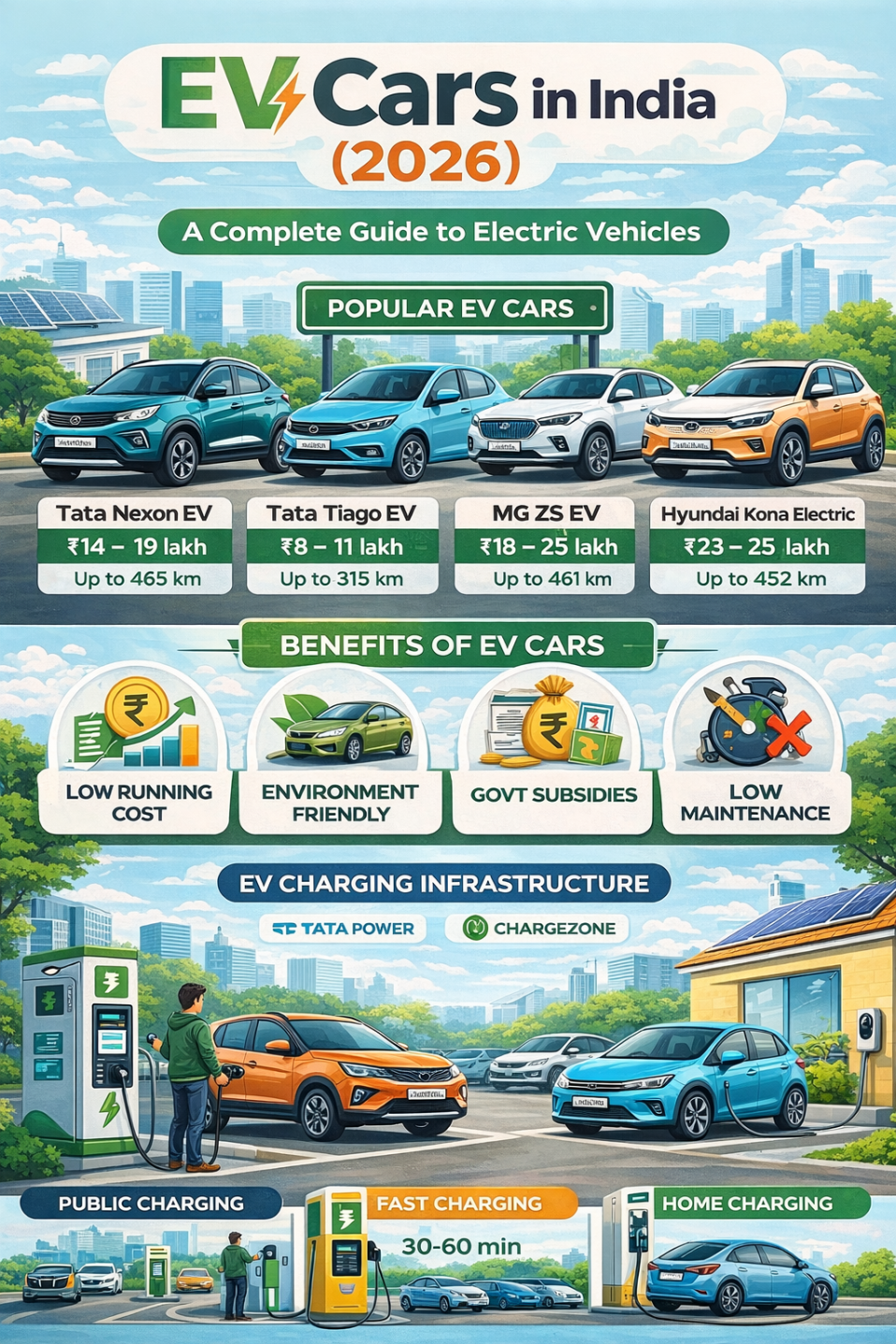
⚡🚗
Electric vehicles (EVs) are rapidly gaining popularity in India as the country moves toward a cleaner and more sustainable transportation system. Rising fuel prices, growing environmental concerns, and government incentives have encouraged many consumers to consider electric cars instead of traditional petrol or diesel vehicles.
Major automakers such as Tata Motors, Mahindra, Hyundai, MG Motor, and BYD are investing heavily in EV technology and launching new electric models in the Indian market.
In this detailed guide, we will cover:
- What EV cars are
- Benefits of electric vehicles
- EV charging infrastructure in India
- Running cost comparison
- Best electric cars available in India
- EV comparison table (price, range, charging time)
- Future of EV cars in India
What is an EV Car?
An electric vehicle (EV) is a car powered by an electric motor and rechargeable battery instead of an internal combustion engine that runs on petrol or diesel.
Electric vehicles store energy in lithium-ion batteries, which supply electricity to the motor to drive the vehicle.
Unlike conventional cars, EVs produce zero tailpipe emissions, making them environmentally friendly and efficient.
Types of Electric Vehicles
Electric cars come in different types depending on their power source.
1. Battery Electric Vehicles (BEVs)
These vehicles run entirely on electricity.
Examples include:
- Tata Nexon EV
- MG ZS EV
They must be charged using an external power source.
2. Hybrid Electric Vehicles (HEVs)
Hybrid vehicles use both a petrol engine and an electric motor.
Examples include:
- Toyota Camry Hybrid
These vehicles automatically switch between petrol and electric power.
3. Plug-in Hybrid Vehicles (PHEVs)
Plug-in hybrids combine a battery-powered electric motor and a petrol engine, and the battery can be charged externally.
Why EV Automobiles Are Growing in Popularity in India
Electric vehicles are gaining popularity due to multiple advantages.
1. Lower Running Cost
Electric cars are significantly cheaper to run compared to petrol and diesel vehicles.
Average cost comparison:
| Vehicle Type | Cost per km |
| Petrol Car | ₹7 – ₹10 |
| Diesel Car | ₹6 – ₹8 |
| Electric Car | ₹1 – ₹2 |
For daily commuters, EVs can save ₹50,000–₹1 lakh per year on fuel costs.
2. Government Subsidies
The Indian government encourages EV adoption through programs like:
- FAME II subsidy
- State EV policies
- Road tax exemptions
- Registration fee waivers
The cost of buying an electric car is lowered by these incentives.
.
3. Low Maintenance Cost
Electric vehicles have fewer moving parts than petrol or diesel cars.
EVs do not require:
- Engine oil changes
- Clutch replacements
- Complex transmission systems
This reduces maintenance costs significantly.
4. Environment Friendly
Electric vehicles produce zero exhaust emissions, helping reduce pollution levels in cities like:
- Delhi
- Mumbai
- Bangalore
- Chennai
EVs play an important role in reducing carbon emissions and improving air quality.
EV Charging Infrastructure in India
One of the key factors influencing EV adoption is charging infrastructure.
India is rapidly expanding its EV charging network.
Major charging providers include:
- Tata Power
- ChargeZone
- Ather Energy
Types of EV Charging
1. Home Charging
Most EV owners charge their vehicles at home using a wall-mounted charger.
Charging time:
6–8 hours
This is the most convenient charging method.
2. Fast Charging
Fast chargers can charge a vehicle battery much faster.
Charging time:
30–60 minutes for 80% charge.
Fast charging stations are commonly found at highways, malls, and commercial areas.
3. Public Charging Stations
Public charging stations are expanding across major cities.
These are typically located in:
- Shopping malls
- Office complexes
- Parking areas
- Highways
Best EV Cars in India (2026)
Here are some of the best electric vehicles available in the Indian market.
1. Tata Nexon EV
Price: ₹14 – ₹19 lakh
One of the most well-liked electric SUVs in India is the Nexon EV.
Key features:
- Range up to 465 km
- Fast charging support
- Advanced infotainment system
- High safety ratings
2. Tata Tiago EV
Price: ₹8 – ₹11 lakh
Highlights:
- Affordable EV option
- Ideal for city driving
- Compact design
Range:
Up to 315 km.
3. MG ZS EV
Price: ₹18 – ₹25 lakh
Features:
- Premium interior
- Advanced safety features
- Fast charging support
Range:
461 km.
4. Hyundai Kona Electric
Price: ₹23 – ₹25 lakh
Highlights:
- Long driving range
- Powerful electric motor
- Premium features
Range:
452 km.
5. Mahindra XUV400
Price: ₹15 – ₹19 lakh
Features:
- Strong performance
- Spacious interior
- Large battery capacity
Range:
Up to 456 km.
EV Cars Comparison Table (Range, Price & Charging)
Here is a comparison of some of the most popular EVs available in India.
| EV Car | Price (Approx) | Range | Charging Time | Segment |
| Tata Tiago EV | ₹8 – ₹11 lakh | 250 – 315 km | 3.6 – 6 hrs | Hatchback |
| Tata Nexon EV | ₹14 – ₹19 lakh | 325 – 465 km | 5 – 8 hrs | SUV |
| MG ZS EV | ₹18 – ₹25 lakh | 461 km | 8 – 9 hrs | SUV |
| Hyundai Kona Electric | ₹23 – ₹25 lakh | 452 km | 6 – 8 hrs | SUV |
| Mahindra XUV400 | ₹15 – ₹19 lakh | 375 – 456 km | 6 – 7 hrs | SUV |
EV Running Cost vs Petrol Cars
Electric vehicles offer massive savings in daily running costs.
Example monthly cost comparison.
| Vehicle | Monthly Fuel Cost |
| Petrol Car | ₹10,000 |
| Diesel Car | ₹8,000 |
| Electric Car | ₹2,000 |
Over 5 years, EV owners can save ₹3–5 lakh on fuel expenses.
Challenges of EV Cars in India
Despite their advantages, EVs still face some challenges.
Limited Charging Infrastructure
Although improving rapidly, charging stations are still limited in smaller cities.
Higher Initial Cost
EVs are usually more expensive than petrol vehicles due to battery costs.
However, government incentives help reduce prices.
Charging Time
Charging an EV takes longer compared to refueling a petrol car.
Fast chargers help reduce charging time significantly.
Upcoming EV Cars in India
Several new electric vehicles are expected to launch in the Indian market.
Upcoming models include:
- Tata Harrier EV
- Mahindra XUV.e8
- Maruti eVX
These vehicles will offer better range, advanced technology, and improved battery performance.
Should You Buy an EV Car in India?
Buying an EV makes sense if:
✔ You drive mainly in the city
✔ You want lower running costs
✔ Charging stations are available nearby
✔ You want an eco-friendly vehicle
However, if you frequently travel long distances, charging infrastructure may still be a concern.
Future of Electric Cars in India
The future of EVs in India looks very promising.
Government policies aim to increase EV adoption significantly in the coming years.
Automakers are investing billions in EV development, battery technology, and charging infrastructure.
Within the next decade, electric vehicles could become one of the dominant segments in the Indian automotive market.
Conclusion
Electric vehicles are revolutionizing the automobile industry in India. With lower running costs, government incentives, reduced emissions, and improving charging infrastructure, EVs are becoming an attractive option for many car buyers.
Popular models like the Tata Nexon EV, MG ZS EV, and Mahindra XUV400 are leading the EV revolution in India.
As technology improves and more models are launched, electric vehicles will likely play a major role in shaping the future of mobility in India.